Shape Sorting Toys for Toddlers: Choosing the Right Educational Toy

A toddler trying to push a triangle into a round hole is doing more than playing. They are testing an idea, adjusting their hand, noticing what fits, and learning that objects have edges, corners, and positions.
That small moment is why shape sorting toys for toddlers remain a favorite in homes, nurseries, and Montessori-inspired play spaces across the UAE and GCC. The best ones are simple enough to invite independent play, but rich enough to build shape recognition, matching skills, fine motor control, and early spatial thinking.
The challenge is choosing the right toy. A sorter that is too easy may lose your child’s interest. One that is too advanced can lead to frustration. The right choice depends on your toddler’s age, current abilities, safety needs, and how the toy will be used at home.
What shape sorting toys are and why they matter |shape sorting toys for toddlers
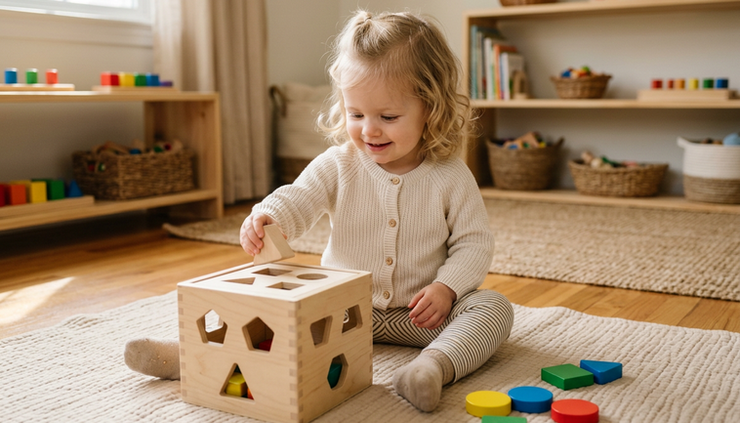
Shape sorting toys are toys that ask a child to match an object to a specific opening or space. A classic example is a cube with holes for a circle, square, triangle, and star. The toddler must choose a piece, turn it in the right direction, and place it through the matching hole.
That sounds simple, but several skills work together:
Recognizing shapes by their outline
Comparing one object with another
Turning and rotating pieces
Using both hands together
Understanding “fits” and “does not fit”
Building patience through trial and error
For toddlers, this is early problem-solving. They learn that a shape is not only a name. It is something they can feel, move, compare, and position.
Shape sorters are also closely linked to spatial relationships. A child begins to understand ideas like inside, outside, above, below, next to, turned around, and upside down. These concepts support later skills in puzzles, drawing, building, early math, and practical daily tasks.
How shape-matching activities work for toddlers
Shape-matching activities work by giving toddlers a clear visual and physical goal. The child sees a space, holds a piece, and tries to connect the two.
At first, the activity may look random. A younger toddler may tap pieces, place them on top of the toy, or try every opening. That is normal. They are learning through touch and repetition.
Over time, the process becomes more intentional:
The child notices differences between shapes.
They compare the piece with the opening.
They rotate or flip the piece.
They test whether it fits.
They remember the solution next time.
This is why shape matching toys for toddlers work best when they allow hands-on trial and error. The child should be able to explore without constant correction.
A simple example at home
Place two shapes in front of your toddler, such as a circle and a square. Show the matching spaces. Say, “This one is round. Let’s try the round hole.” Then pause.
If your child tries the square hole first, let them test it. A mismatch teaches through experience. Offer help only when they seem stuck or upset.
That pause is powerful. It gives your toddler time to think, not just follow instructions.
Shape sorting toys, pegged puzzles, and stacking toys are not the same
Parents often use these terms together, but each toy type supports learning in a slightly different way. Many families in the UAE search for educational puzzles for toddlers, Montessori puzzle toys, and learning toys for toddlers without knowing which format fits their child best.
Toy type | How it works | Best for | What to watch for |
Shape sorting toys | Child places shapes into matching holes or slots | Matching, rotation, spatial reasoning, problem-solving | Pieces should be large, easy to grip, and not too many at once |
Pegged puzzles | Child places pieces into matching flat spaces, often using small knobs | Shape recognition, hand control, visual matching | Pegs must be secure and easy for little fingers to hold |
Stacking toys | Child stacks rings, blocks, cups, or shapes by size or order | Hand-eye coordination, balance, size comparison | Tall stacks may topple, so use on a safe surface |
Shape sorting toys build 3D thinking
A shape sorter often requires a toddler to move a piece through space. They may need to rotate a cube, turn a triangle, or push a cylinder through a matching opening. This makes it especially useful for spatial relationships.
Pegged puzzles support visual matching
Pegged puzzles are usually flatter. A toddler sees a shape-shaped space and places the matching piece into it. The knob or peg helps them lift and place the piece.
The main difference between shape sorting toys and pegged puzzles is the level of depth and movement. A sorter often involves inserting a piece into a 3D container. A pegged puzzle usually involves placing a piece into a flat board.
Stacking toys teach order and balance
Stacking toys are not usually shape sorters, although some include shape or color matching. They help toddlers compare sizes and control movement. A ring stacker, for example, teaches big and small, top and bottom, and steady hand placement.
How to choose an age-appropriate shape-sorting toy
A good toy meets a child where they are. Age labels help, but your toddler’s current abilities matter just as much.
Check the piece size
For toddlers, bigger pieces are usually better. Pieces should be large enough to hold comfortably and too large to be a choking risk.
Avoid tiny shapes, loose beads, or parts that could break off. If a piece looks small enough to fit fully into a young child’s mouth, it is not suitable for unsupervised toddler play.
For families buying shape sorting toys UAE online, check product photos, age grading, and measurements when available. Do not rely only on how large the toy looks in a picture.
Choose pieces that are easy to handle
Toddlers are still building finger strength and coordination. Look for:
Chunky shapes
Rounded edges
Simple outlines
Easy-grip knobs on puzzles
Openings that are clear and not overly tight
A toy should offer a challenge, but not require adult-level precision. If your child must force every piece, the design may be too difficult.
Think about material and durability
Common materials include wood, plastic, silicone, and fabric. Each has benefits.
Wooden toys often feel sturdy and can suit Montessori-inspired playrooms. They should have smooth edges and child-safe finishes. Plastic toys can be lightweight and easy to clean, which is helpful in busy homes or shared play areas. Fabric sorters may suit younger toddlers, though they usually offer less precise shape practice.
For wooden shape puzzles for kids, inspect the finish. Paint should not chip easily, and the surface should feel smooth to the touch.
Match the toy to your child’s current abilities
A child who is new to matching may do best with three basic shapes: circle, square, triangle. A child who already matches simple shapes may enjoy more pieces, colors, or double challenges.
Use this simple guide:
Child’s current stage | Better toy choice |
Explores by mouthing and banging | Large, soft, simple pieces with close supervision |
Can place objects into containers | Basic sorter with 2 to 4 easy shapes |
Recognizes simple shapes | Shape sorter or pegged puzzle with 4 to 6 shapes |
Enjoys problem-solving | Multi-shape sorter, nesting puzzle, or shape and color sorting toys |
Gets frustrated quickly | Start with fewer pieces and add more later |
A toy is age-appropriate when your toddler can succeed with some effort. If every attempt ends in adult help, simplify the activity.

Safety features parents should check before buying
Safety comes before learning value. Before buying shape recognition toys for toddlers or any matching toys for toddlers, check these features.
Look for smooth edges and secure parts
Run your hand along the pieces if shopping in person. Edges should feel smooth, not sharp or splintered. Pegs, knobs, lids, hinges, and decorative parts should be firmly attached.
For online purchases, read descriptions carefully and avoid toys with many tiny accessories for younger toddlers.
Check paint, finish, and smell
Choose toys with child-safe finishes. Strong chemical smells, flaking paint, or rough varnish are warning signs. This matters in warm GCC climates, where toys may be stored in cars, balconies, or outdoor play areas and exposed to heat.
Keep wooden and plastic toys indoors when possible. Heat and direct sun can affect materials over time.
Avoid unsafe extras
Some toys add lights, sounds, magnets, batteries, or removable screws. These are not always needed for shape learning.
For toddlers, simpler is often safer and more focused. If a toy has batteries, make sure the battery compartment is secured with a screw. If it uses magnets, check that they are fully enclosed and cannot come loose.
Choose easy-to-clean designs
Toddlers explore with their hands and mouths. Choose toys that can be wiped clean. Avoid deep cracks, fabric that traps moisture, or parts that are hard to dry if the toy will be shared between siblings or used often.
Practical parent-child activities that make sorting more useful
A toy does not teach on its own. A few minutes of shared play can turn a simple sorter into a rich learning moment.
Start with fewer pieces
Put out two shapes instead of the full set. Try a circle and a square first because they look and feel very different. Add the triangle once your child understands the goal.
This reduces visual clutter and helps toddlers focus.
Use simple language while playing
Narrate what your child is doing:
“You found the circle.”
“The triangle has corners.”
“Let’s turn it.”
“It fits.”
“That one is too wide for this space.”
Short phrases work better than long explanations. Repetition helps toddlers connect words with actions.
Turn matching into a room activity
Shape learning does not have to stay on the mat. Try a quick shape hunt:
Find a round plate.
Point to a square cushion.
Look for a rectangle on a door.
Match a toy block to the shape sorter piece.
These toddler shape learning activities build the link between toy play and the real world.
Let your child solve small problems
If the piece does not fit, avoid immediately fixing it. Try saying, “Turn it a little,” or “Try another space.” Give your child a moment to test a new idea.
That small struggle is part of the learning.
Common buying mistakes to avoid
The most expensive toy is not always the best one. A clear, well-made sorter often works better than a busy toy with too many features.
Buying too many pieces too soon
A sorter with many shapes can look impressive, but it may overwhelm a young toddler. Start simple. Add complexity as your child grows.
Choosing a toy only by age label
Age labels are useful, but children develop at different speeds. A 2-year-old who is new to puzzles may need a simpler toy than a younger child who has practiced often.
Watch how your child plays now, not only what the package says.
Picking toys that do the work for the child
Some electronic toys reward any action with lights or sounds. That can be fun, but it may distract from the main task of matching and problem-solving.
For Montessori-inspired play, choose toys where the child controls the action and can see the result clearly.
Ignoring storage and missing pieces
Shape sorters lose value when pieces disappear. Choose designs with a container, lid, tray, or simple storage system. At home, keep the toy in one basket so setup and cleanup stay easy.
Buying only for appearance
Neutral wooden toys photograph beautifully, but they still need to be practical. Check the grip, weight, finish, and difficulty level before choosing.
If a Markton Forten shape puzzle or sorter has large pieces, smooth edges, sturdy materials, and an age-appropriate design, it can fit well into a Montessori-style toy rotation. The same rule applies to any brand: features matter more than looks.
Supervision tips for safer, calmer play
Toddlers learn best when adults stay nearby without taking over.
Keep these supervision habits in mind:
Inspect toys often for cracks, loose pegs, chipped paint, or broken parts.
Sit close during play, especially with younger toddlers.
Remove damaged toys right away.
Store advanced puzzles away until your child is ready.
Keep small sibling toys separate from toddler play areas.
Rotate toys instead of offering too many at once.
For shared homes, nurseries, or playdates, check the floor before play starts. Small objects from older children’s toys can mix into toddler spaces easily.
How to build a simple Montessori-inspired shape play shelf
A calm setup helps toddlers focus. You do not need many toys.
Try placing these on a low shelf or in easy baskets:
One basic shape sorter
One pegged puzzle with large knobs
One stacking toy
A small basket of real-life matching objects, such as a round lid and square coaster
Rotate items every week or two. If your child is deeply engaged with one toy, keep it out longer.
Parents looking for educational toys UAE or Montessori toys for toddlers can use this approach to buy fewer, better toys. A small group of well-chosen toys often supports deeper play than a crowded shelf.
FAQ
What are shape sorting toys?
Shape sorting toys are toys where toddlers match shaped pieces to matching holes, slots, or spaces. They help children practice shape recognition, hand-eye coordination, and early problem-solving.
How do shape-matching activities work?
They work by asking a child to compare a piece with a space, move it, rotate it, and test whether it fits. This hands-on process helps toddlers understand shapes and spatial relationships through play.
What is the difference between shape sorting toys and pegged puzzles?
Shape sorting toys usually involve placing pieces into 3D openings or containers. Pegged puzzles are usually flat boards where a child places pieces into matching spaces, often using small knobs for grip.
How do parents choose an age-appropriate shape-sorting toy?
Choose based on piece size, ease of handling, number of shapes, material, safety features, and your child’s current ability. Start with fewer, larger, simpler shapes, then add more challenge over time.
What safety features should parents check before buying?
Check for large pieces, smooth edges, secure pegs or lids, child-safe finishes, strong construction, and easy cleaning. Avoid loose magnets, unsecured batteries, tiny parts, and toys that show signs of chipping or damage.
The best toy is the one your toddler can really use
Shape sorters, pegged puzzles, and stacking toys all support early learning, but they do it in different ways. The right choice is safe, sturdy, easy to handle, and just challenging enough for your child’s current stage.
Start simple. Sit nearby. Let your toddler try, turn, test, and try again. That is where the real learning happens.


Comments