Why Do Toddlers Ask Why So Much and How to Support Curiosity Through Play

The “why” stage can feel endless. Why is the sky bright? Why do we stop at red lights? Why is dinner hot? Why can’t we go outside at noon in the summer? One question turns into five more before you have even finished answering the first.
That can be tiring, but it is also a good sign. When toddlers ask “why,” they are not trying to test patience. They are building an understanding of how the world works. Their brains are connecting language, memory, patterns, emotions, and cause and effect.
For UAE parents, this often shows up during everyday routines: school drop-off, supermarket trips, prayer time, beach visits, mall walks, or indoor play during hot afternoons. The key is not to give a perfect explanation every time. The key is to keep curiosity alive and give children chances to explore with their hands, senses, and imagination.

Why do toddlers ask “why” so much?
The short answer to why do toddlers ask why is simple: they are trying to understand cause, meaning, and rules.
Toddlers are at an age where their language is growing quickly. They can name more things, understand more instructions, and notice more details. But they do not yet understand time, logic, safety, feelings, or social rules the way adults do.
So “why?” becomes a useful tool.
A toddler might ask:
“Why is the car stopping?”
“Why is the baby crying?”
“Why can’t I touch the oven?”
“Why do I have to sleep?”
“Why did the tower fall?”
Each question is a small request for connection. Sometimes it means, “Explain this.” Sometimes it means, “Talk to me.” Sometimes it means, “I want to keep this conversation going.”
That is why a child may ask “why?” even after hearing the answer. Repetition helps toddlers process information. It also helps them feel secure.
“Why?” is more than a question
To adults, “why?” sounds like a request for facts. To toddlers, it can do much more.
It may be a way to:
Practice new language
Understand routines and limits
Get comfort during change
Test what happens next
Invite an adult into play
Make sense of big feelings
For example, when a toddler asks, “Why can’t I have ice cream now?” the question may not be about nutrition. It may be about disappointment. A useful answer might sound like:
“Because lunch helps your body feel strong. We can have ice cream after dinner.”
That answer gives a reason and a boundary. It also keeps the tone calm.
When children hear thoughtful answers, they learn that questions are welcome. This supports confidence and communication, both important parts of early childhood development.
How curiosity supports cognitive development
Curiosity is not a bonus skill. It is central to learning.
When toddlers wonder about something, their attention sharpens. They observe, compare, guess, and remember. This is part of cognitive development in toddlers, which includes thinking, problem-solving, memory, attention, and early reasoning.
A curious toddler may:
Sort toy animals by size without being asked
Drop objects to see which makes the loudest sound
Ask why a shadow moves
Try different puzzle pieces until one fits
Pour water from one cup to another again and again
These moments may look simple, but they build important brain pathways. Children learn best when they are active participants, not passive listeners.
That is where toddler curiosity, cognitive development in toddlers, learning through play, cause and effect for toddlers, early childhood development, toddler learning activities, educational toys for toddlers, parenting tips for toddlers, UAE parents, and educational toys UAE all connect in a practical way: children need real experiences they can touch, test, and repeat.
How children learn cause and effect
Cause and effect means understanding that one action can make something else happen.
For adults, this feels obvious. For toddlers, it is a major discovery.
When a child presses a button and music plays, they learn, “I did that.” When they knock down a block tower, they learn that force changes structure. When they water a plant and see it grow over time, they start to understand care, time, and change.

Simple cause and effect examples toddlers understand
Action | Result | What the child learns |
Push a toy car | It rolls forward | Force creates movement |
Stack blocks too high | The tower falls | Balance matters |
Shake a rattle | It makes sound | Movement can create noise |
Mix paint colors | A new color appears | Materials can change |
Turn a page | The story continues | Actions can reveal new information |
These tiny experiments are early science. They help children predict, adjust, and try again.
Parents do not need to have every answer
Many parents feel pressure to answer every “why?” with a clear, correct explanation. That is not necessary.
Toddlers do not need a lecture about weather systems when they ask why clouds move. They need a short answer that fits their age.
Try responses like:
“The wind is pushing the clouds.”
“The water spilled because the cup tipped.”
“Your shoes protect your feet outside.”
“The light turned green, so cars can go.”
It is also fine to say, “I’m not sure. Let’s find out together.”
That sentence teaches something powerful. It shows that learning does not stop with adults. It also turns a question into a shared activity.
A helpful formula is:
Give a short answer.
Ask what they think.
Let them test or observe if possible.
For example:
“Why did the ice melt?”
“The room is warmer than the freezer. What do you think will happen if we put another ice cube near the window?”
Now the child is not only hearing an answer. They are thinking like a little investigator.
Five ways parents can encourage curiosity at home
Curiosity grows when children feel safe to ask, explore, and make small mistakes. These five habits can help.
1. Answer with simple language
Use words your toddler already knows, then add one new idea.
Instead of saying, “Evaporation happens when water changes into vapor,” try:
“The sun makes the water warm, and it slowly disappears into the air.”
Short answers are easier to remember.
2. Ask open questions
Open questions help toddlers think beyond yes or no.
Try:
“What do you notice?”
“What do you think will happen?”
“How can we fix it?”
“Which one feels heavier?”
“Why do you think it fell?”
These questions build reasoning and vocabulary.
3. Let children repeat activities
Adults often want to move on. Toddlers often want to do the same thing 20 times.
That repetition matters. Pouring, stacking, sorting, opening, closing, pressing, and fitting all help toddlers master patterns.
4. Create safe spaces for experiments
A tray, mat, balcony corner, or washable table area can become an exploration zone.
Good materials include:
Cups and spoons
Blocks
Toy cars
Large beads
Animal figures
Chunky puzzles
Water-safe toys
Cardboard tubes
Supervision matters, especially with water, small parts, and climbing.
5. Welcome messy learning when possible
Messy play can be hard in apartments and shared spaces, but it does not need to be extreme. A small bowl of water, a few ice cubes, or washable paint on a tray can offer rich learning.
For hot UAE afternoons, indoor sensory play can be a practical way to keep children engaged without needing a long outdoor trip.
How learning through play supports curious minds
Play is how toddlers practice life.
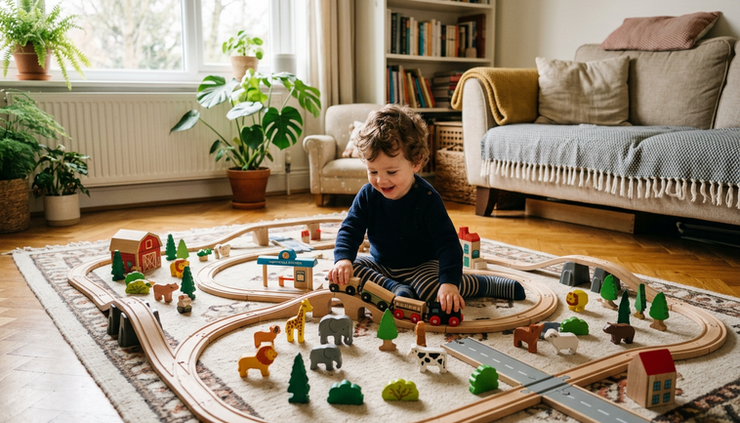
Through play, children test ideas without fear of being wrong. A block can become a phone. A box can become a house. A toy kitchen can become a family restaurant. This kind of pretend play builds language, memory, social understanding, and flexible thinking.
Learning through play also helps children connect ideas across different settings.
A toddler who plays with toy fruits may later recognize apples and bananas in the supermarket. A child who builds roads for cars may ask more questions during a real drive. A child who plays with animal figures may become more interested in books about farms, deserts, or oceans.
Play makes learning concrete. Toddlers do not only hear “big” and “small.” They hold a big block and a small block. They do not only hear “fast” and “slow.” They roll cars down ramps and watch the difference.
Choosing educational toys that encourage exploration
The best toys for curious toddlers are usually open-ended. That means children can use them in more than one way.
A toy that only does one thing may entertain for a short time. A toy that invites building, sorting, pretending, matching, or problem-solving can grow with the child.
Look for toys that support:
Hands-on discovery
Blocks, stacking toys, shape sorters, and activity cubes help children test ideas physically.
Problem-solving
Peg puzzles, matching games, and simple construction sets help children try, adjust, and try again.
Cause and effect
Ramp toys, musical toys, gears, and pop-up toys show children how actions create results.
Pretend play
Play kitchens, doctor kits, dollhouses, tool benches, and animal sets support language and imagination.
Sensory exploration
Textured balls, water play toys, sand tools, and safe tactile materials help children learn through touch.
If you are browsing for educational toys UAE, useful internal categories might include educational toys for toddlers, STEM and cause-and-effect toys, wooden puzzles, building blocks, and pretend play toys.
The goal is not to fill the house with toys. It is to choose a few strong play materials that invite questions.
Simple everyday “why?” activities for toddlers
You do not need a planned lesson to support curiosity. Daily life offers plenty of chances.
Try a melting ice activity
Place two ice cubes in different spots, one near a sunny window and one in a shaded area. Ask:
“Which one will melt first?”
This supports observation, prediction, and early science.
Build and knock down towers
Use blocks or plastic cups. Build towers of different heights. Ask:
“Why did this one fall?”
Children learn balance, height, and stability through trial and error.
Sort laundry together
Ask your toddler to match socks or sort clothes by color. Ask:
“Why do these go together?”
This builds categorizing skills and attention to detail.
Make a sink or float bowl
Use a bowl of water and safe objects such as a spoon, sponge, leaf, or plastic toy. Ask:
“What do you think will stay on top?”
This is a classic cause-and-effect activity.
Watch shadows move
In the morning or late afternoon, look at shadows indoors or outside when it is cool enough. Ask:
“Why is your shadow changing?”
This encourages observation without needing a complicated explanation.
Cook simple foods together
Stirring batter, peeling bananas, spreading soft cheese, or mixing yogurt with fruit can spark questions about texture, temperature, and change.
Keep tasks safe and age-appropriate. Toddlers love to help when the job feels real.

FAQ
Is it normal for toddlers to ask “why?” all day?
Yes. Repeated “why?” questions are a normal part of toddler development. Children use questions to learn language, understand rules, and make sense of the world.
What age does the “why” phase usually start?
Many children begin asking frequent “why?” questions around the preschool years, though some start earlier. The timing varies based on language development, personality, and environment.
What should I do when I feel tired of answering?
Use short answers. You can also turn the question back gently by asking, “What do you think?” If you need a break, say, “I will answer one more question, then we will read quietly.”
Are educational toys necessary for curiosity?
No single toy is necessary. Children can learn through household objects, nature, books, and conversation. Good educational toys can help by giving toddlers safe, repeatable ways to explore.
How can I support curiosity without creating a mess?
Use contained activities. Try trays, sorting baskets, puzzles, blocks, sticker books, magnetic tiles, or water play with a towel underneath. Small setups can still offer rich learning.
Final thought: do not silence the “why?”
The “why?” stage can be noisy, repetitive, and inconvenient. It can also be one of the clearest signs that a child is thinking deeply.
Every question is a small window into how a toddler sees the world. Some answers can be quick. Some can become play. Some can become stories, experiments, or shared discoveries.
When children ask why the tower fell, why the moon follows the car, or why they need sandals on hot ground, they are practicing curiosity. They are learning that ideas have reasons and actions have results.
So when the next “why?” arrives, pause when you can. Give a simple answer. Ask a question back. Offer something to touch, build, sort, pour, or test.
Curiosity grows best when children feel heard, and play gives that curiosity somewhere to go.


Comments